
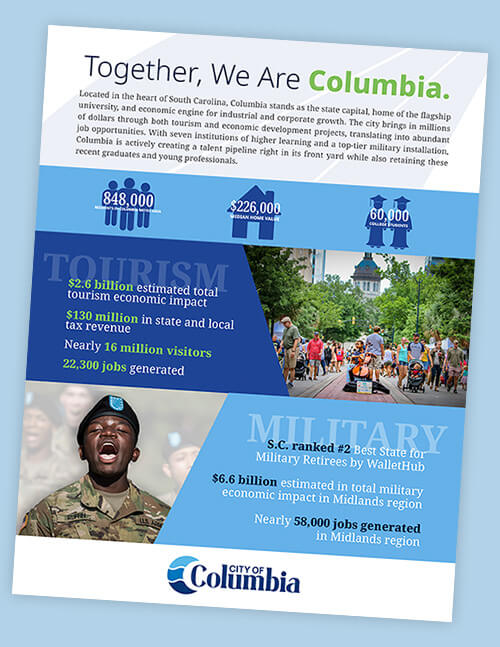
Located in the heart of South Carolina, Columbia stands as the state capital, home of the flagship university, and economic engine for industrial and corporate growth.
A Brief History of Columbia
THE 1700s
Long before Columbia’s official founding, its location played a vital role in the development of South Carolina. The area known as The Congarees—a frontier outpost on the west bank of the Congaree River—served as a strategic trading point at the head of navigation for the Santee River system. In 1754, a ferry was established to connect the fort with the higher eastern bank, laying the groundwork for future settlement.
On March 22, 1786, the South Carolina General Assembly passed legislation introduced by Senator John Lewis Gervais to establish a new, centrally located state capital. Though other names were proposed, including “Washington,” Columbia won by a close Senate vote of 11–7. Gervais emphasized the importance of a state capital that would be accessible and inclusive, calling it “a place for all people.”
Planned as the second intentionally designed city in the United States, Columbia was mapped into a two-mile grid of 400 blocks. Streets were designed to be unusually wide—up to 150 feet—based on the (incorrect) belief that mosquitos couldn’t fly more than 60 feet without starving. These broad avenues remain one of Columbia’s signature features.
The city grew steadily under the oversight of the Commission of Streets and Markets, created in 1797 to address sanitation, disorderly conduct, and community maintenance. By the turn of the 19th century, Columbia’s population had already approached 1,000 residents.
THE 1800s
Columbia was formally chartered as a town in 1805. Its first intendent (mayor), John Taylor, would later serve as both Governor of South Carolina and a U.S. Senator. By 1816, the town included more than 250 homes.
Local government funded itself through modest property taxes and service fees, and citizens were expected to contribute labor for street maintenance or pay to be exempt. Early fire safety efforts required residents to own a fire bucket for each chimney, and small brigades—later replaced by volunteer departments—were formed to protect the town.
Columbia became an official city in 1854, establishing a mayoral and alderman system. A city police force soon followed, with officers earning a monthly salary of $16. Meanwhile, Abram Blanding, Columbia’s first teacher and attorney, constructed the city’s original waterworks system, laying the foundation for modern public utilities.
In 1860, Columbia hosted the convention where South Carolina seceded from the Union, marking its pivotal role in national history. Just five years later, in February 1865, much of the city was burned by Union forces during the Civil War. The destruction left scars—dozens of public buildings, homes, and businesses were reduced to rubble. But Columbia’s spirit endured. The people rebuilt their city from the ashes with remarkable resilience and a renewed sense of community. That same spirit of perseverance still defines Columbia today.
THE 1900s
Modernization took hold in Columbia during the 20th century. In 1908, Main Street became the first paved road. Prior to that, pedestrians relied on wooden sidewalks and elevated crossings to avoid muddy streets. An early experiment paving Washington Street with wooden blocks ended when heavy rains sent the blocks floating away—prompting a shift to asphalt.
The city hired its first professional firefighters in 1903 and acquired its first vehicle that same year. In 1934, Columbia purchased the historic federal courthouse at Main and Laurel Streets. By 1937, it became City Hall, a granite structure designed in 1875 by Alfred Bult Mullett, the same architect behind the Eisenhower Executive Office Building in Washington, D.C.
Columbia’s downtown and surrounding neighborhoods continued to grow, and the city emerged as the political, cultural, and educational capital of South Carolina. The presence of the University of South Carolina, founded in 1801, cemented Columbia’s role as a center for academic excellence and a place where leadership and learning intersect. Today, it proudly stands as the state’s flagship university.
THE 2000s AND THE FUTURE
Entering the 21st century, Columbia embraced revitalization with energy and vision. Transformational developments throughout the city have helped usher in a new era of innovation, connectivity, and community-focused growth. From the rejuvenated Main Street corridor to the emerging BullStreet District, Columbia has reclaimed its role as a vibrant destination for residents, entrepreneurs, and visitors alike.
One of the city’s most anticipated milestones is the revitalization of Finlay Park, one of downtown’s most iconic green spaces. Once a symbol of community pride, the park is being thoughtfully reimagined as a vibrant hub for family recreation, public art, performances, and wellness. With its reopening on the horizon, Finlay Park is poised to reconnect generations of Columbians and offer new memories in a refreshed, inclusive environment.
Another major step toward progress is the City’s strategic investment in 1401 Main Street, a historic building that will soon house the consolidated Municipal Services Complex. This adaptive reuse project reflects Columbia’s commitment to modernizing government services while preserving the architectural heritage of our downtown core. The relocation of departments like Business License, Neighborhood Safety, and Community Development into one accessible location will enhance efficiency and customer service for all residents and businesses.
Today, Columbia stands proudly as a city that blends entrepreneurship, education, government, and recreation into a uniquely dynamic and welcoming environment. The City continues to invest in strong neighborhoods, inclusive economic opportunity, resilient infrastructure, youth development, and sustainability—all shaped by input from our residents and partners.
We are excited for the future of our great city and the growing relationships with our neighborhoods, businesses, and visitors.